

AI Employee Memory & Knowledge
AI employee memory: what a Teammate remembers on its own, what it looks up in company knowledge, and how a job done once becomes one it can repeat.
An assistant that starts from zero every time makes you explain the business again in every conversation. A Teammate does not. It keeps what it learns, it can say what it did last week, and it gets quicker at jobs it has done before.
There are two different things here, and it helps to keep them apart. Memory is what the Teammate learned by working with you. Knowledge is what your company wrote down, which it looks up.
What it remembers
| Kind | What it holds | The question it answers |
|---|---|---|
| Facts | People, preferences, decisions, how your team defines things | "What does this team mean by a stalled deal?" |
| What happened | Its own conversations and the actions it took, per thread | "Did you already send that reminder?" |
| How to do a job | The route that worked, saved as a skill | "How did we produce this report last time?" |
Nobody fills these in. The Teammate writes them as it works. When the team settles that "stalled" means ten days without activity, it keeps that, and the next request that uses the word gets the right answer without a follow-up question.
 Slack#sales-emea0 of 3
 11
Nobody defined stalled in this request. It used the definition the team settled on last week.
Every request starts with recall. What it already knows about the people and the topic is in front of it before it begins, which is why it does not ask twice.
One memory across every channel
Memory belongs to the Teammate, not to a platform. A preference someone states in Google Chat is known in Slack. A job it ran in Teams can be asked about in Discord.
When a fact changes
People change roles and decisions get reversed. When the Teammate learns something that replaces an older fact, the new one wins, and it keeps track of where each fact came from. You can also correct it directly: tell it what is wrong, in any channel, and it updates what it knows.
What it looks up
Company knowledge lives in the Knowledge Base: policies, process documents, product material, pricing. The Teammate searches it when a question calls for it, and it searches there before it looks at the open web.
Answers from the Knowledge Base come with their source. A policy answer names the document and the pages it came from, so the person asking can check it.
| Memory | Knowledge | |
|---|---|---|
| Who writes it | The Teammate, as it works | Your team, in the Knowledge Base |
| Can the Teammate change it? | Yes | No. It reads, it never writes |
| Available from | Builds up over time | Immediately |
| Best for | How your team works and what has been done | What the company has decided and documented |
The Context page
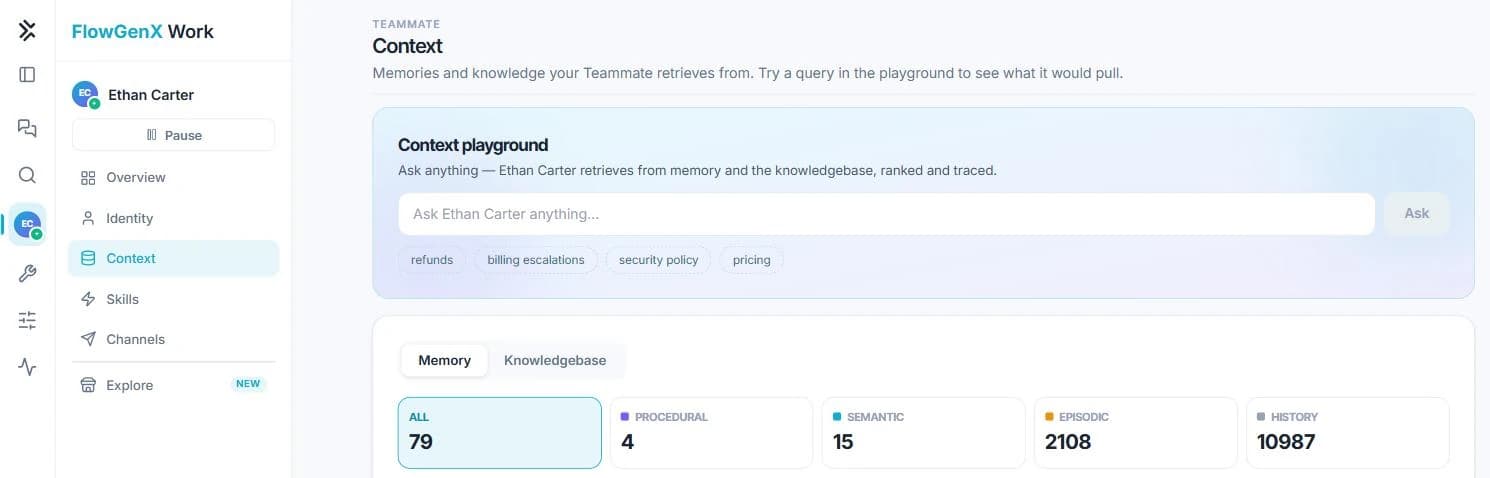
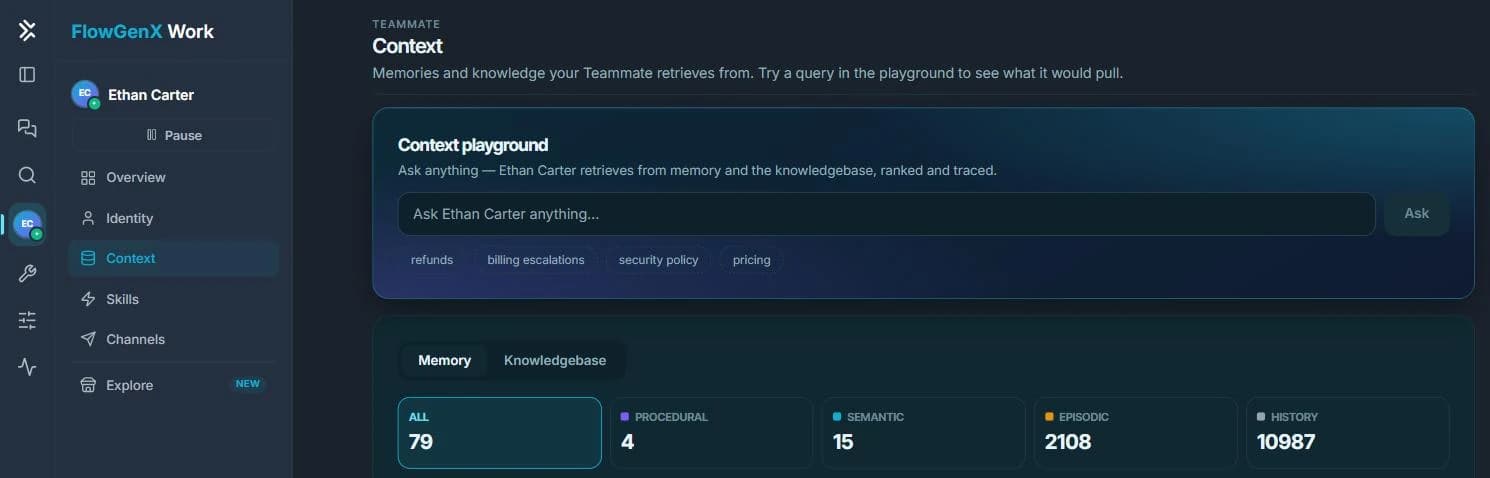
Context in the Teammate section is where you see both.
The playground
Type a question the way a colleague would ask it. The panel on the right shows what the Teammate would retrieve for that question: which entries, from memory or from the Knowledge Base, and how closely each one matched.
Use it before you rely on the Teammate for a topic. If a pricing question brings back last year's price list, you have found the problem before a customer did.
The entries
Below the playground, the page lists what it remembers, grouped by kind, with counters for each. Switch to Knowledgebase to see which collections it can search.
A new Teammate has counters near zero. That is expected. Memory grows as it works. Knowledge is there from the first message.
How it learns
A Teammate improves in the background, not only while it is answering.
After a job is finished, it reviews what happened: what was worth remembering, and whether the route it took is worth keeping. A task it solved by trying three approaches leaves the working approach behind as a skill, so the next similar request is short. You will see these appear on the Skills page.
Anything it writes into its own skills is checked first. Content that looks like an attempt to plant instructions or move data somewhere it should not go is rejected.
Review what accumulates. Open Context and Skills now and then and read the recent entries the way you would read a colleague's notes. A memory reflects what was true when it was written.
Memory and identity
Memory belongs to the account. Renaming a Teammate or rewriting its job description does not clear what it learned. If you re-scope a Teammate to a different role, review the Context page and remove what no longer applies.
Routines
Give your AI Teammate recurring tasks: ask in any channel for a scheduled routine, start from a template, or set a watcher. Results arrive in that thread.
Skills
Named playbooks a Teammate follows. Equip them from the library, write your own, or let the Teammate save a route that worked so the next run is short.