

Every enterprise runs on documents. Invoices, insurance claims, contracts, purchase orders, onboarding forms, lab reports, KYC packets. The daily work of finance, legal, insurance, and healthcare teams is largely the work of reading documents and then doing something about them.
For years, the automation pitch for that work has rested on one technology: OCR. Scan the page, pull out the text, done.
Except you're not done. And that's the problem.
OCR Solves the Easy 20%
OCR and its newer relatives, AI PDF extraction and layout-aware document parsing has gotten genuinely good at turning pixels into structured fields: vendor name, invoice number, line items, totals, dates. For a long time that felt like the hard problem.
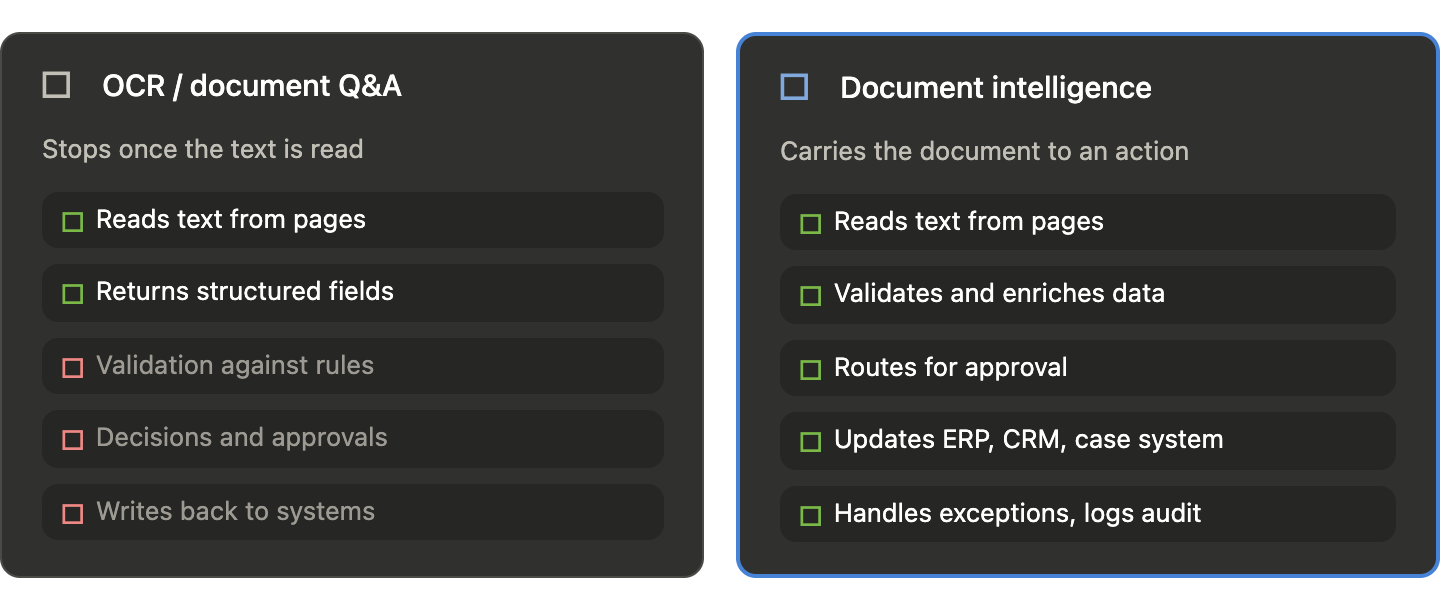
It isn't anymore. Text recognition is the commoditized layer. OCR AI for enterprise documents is now a baseline, not a differentiator. The expensive, error-prone, human-heavy part of document work is everything that follows extraction:
- Is this invoice a duplicate of one we already paid?
- Do the line items match the purchase order and the goods-received note?
- Does this claim fall inside the policy's coverage window?
- Has this contract clause changed from our approved template?
- Who needs to approve this, and what happens if they're out of office?
- Which system of record gets updated, and in what order?
- If something looks wrong, who gets pulled in, and how is that decision logged?
None of that is OCR. All of it is where the time and the risk actually sit. A tool that stops at extraction hands your team a cleaner pile of data and leaves the decisions exactly where they were: on a person, in a spreadsheet, waiting.
The Full Pipeline: From Extraction to Action
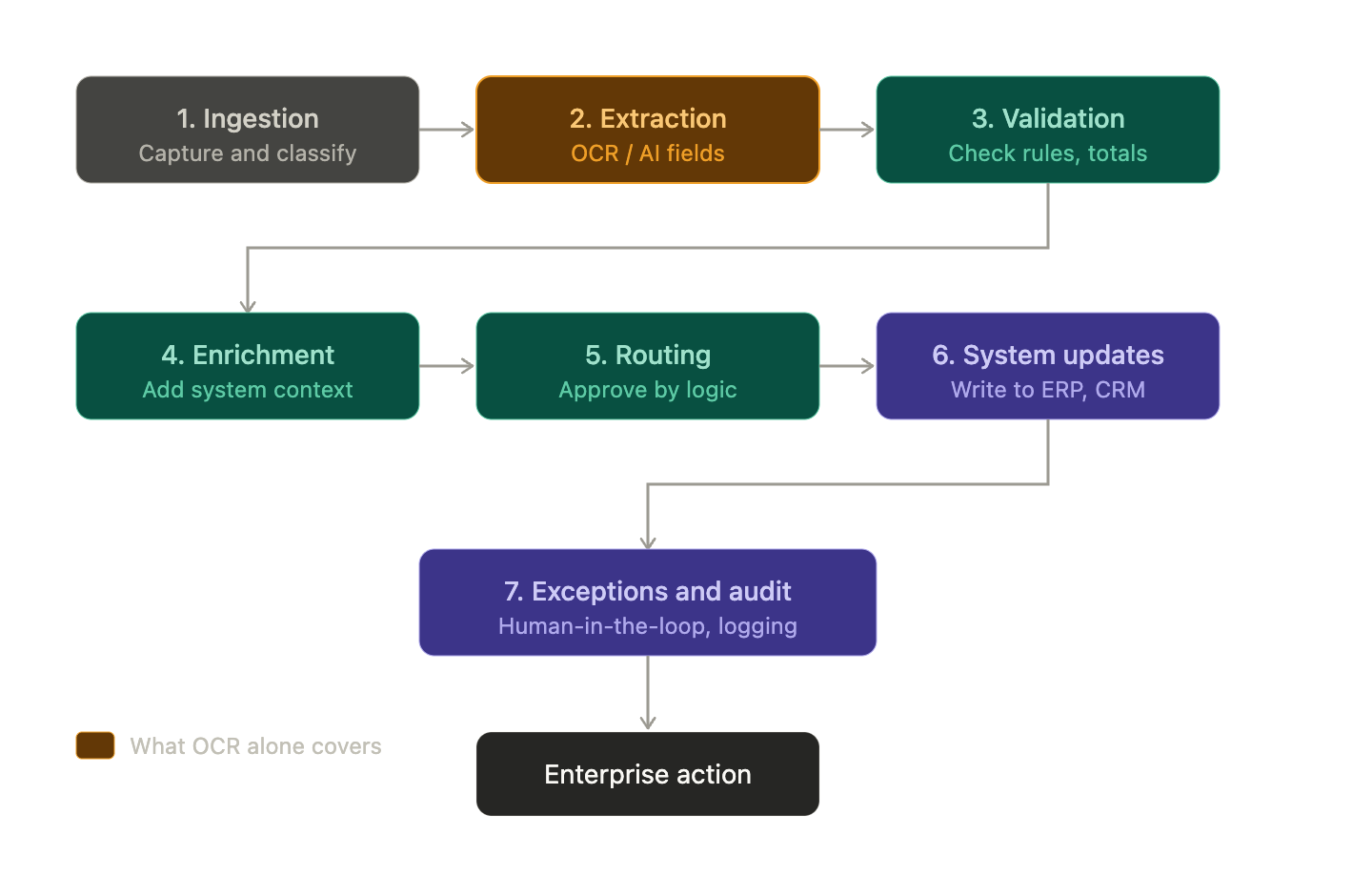
Real intelligent document processing AI is a pipeline, and extraction is only step one. Here's what the full chain looks like when a document genuinely drives a business outcome.
Ingestion. Documents arrive everywhere email attachments, shared drives, scanner output, supplier portals, API uploads. A production-ready system captures them reliably, classifies each one automatically, and routes it to the right process without a human triaging the inbox by hand.
Extraction. This is where OCR and AI PDF extraction earn their keep pulling structured data from messy pages, including handwriting, tables, stamps, and multi-page layouts. Multi-format document AI extraction handles what a single-format tool can't.
Validation. Extracted data gets checked against rules and reality. Are required fields present? Do the numbers add up? Is the tax calculation correct? Validation is the difference between capturing a number and trusting it.
Enrichment via a connected knowledge base. This is where flat data gets context. An enterprise knowledge base AI cross-references your own systems so a vendor name becomes a verified vendor ID, a policy number resolves to a customer record with coverage history, a part number maps to a contract price. Without this step, you have data. With it, you have something you can decide on.
Routing and approval. The enriched record moves through a human-in-the-loop AI workflow based on business logic amount thresholds, risk scores, department, region. Low-risk items flow straight through. Anything requiring judgment goes to the right approver with context already attached.
System write-back. The outcome lands where it belongs: the ERP, the claims platform, the CRM, the case management system. This is the moment the document stops being a file and becomes an action. Enterprise workflow automation AI is what makes that handoff reliable and auditable.
Exception handling and audit. When something doesn't fit a mismatch, a missing field, an out-of-policy value a human is brought in at exactly the right point, with exactly the right information. Every step, automated or not, gets logged for compliance. In regulated industries, that audit trail isn't optional.
Skip any of these steps and you don't have intelligent document processing. You have a smarter scanner.
Human-in-the-Loop Is a Design Choice, Not a Fallback
People often assume the goal of AI workflow automation is to eliminate human involvement entirely. In insurance underwriting, healthcare claims, financial controls, and legal review, that's neither realistic nor desirable. The goal is to remove humans from routine cases that don't need them, and bring them in deliberately for cases that do.
Good document intelligence makes that handoff clean. The system clears straightforward claims on its own and escalates the ambiguous ones with the discrepancy already highlighted, the relevant policy clause already surfaced, and the history already assembled. The reviewer decides in seconds rather than rebuilding the case from scratch.
Done well, human-in-the-loop isn't a backup for when AI fails. It's a governance control you design in on purpose. It's also what makes the whole system trustworthy enough to deploy in regulated environments including HIPAA-compliant AI workflows and SOC2-audited processes.
What This Looks Like in Practice
The same pattern shows up across industries.
AI invoice processing automation in finance: invoices come in, get extracted, validated against the PO and goods-received note, matched to a vendor record, routed for approval by amount, and posted to the ERP. Duplicates and mismatches are flagged before any money moves. What used to be a multi-day chase across three inboxes becomes a governed flow you can watch in real time.
Insurance claims intake: a claim packet gets classified, key fields extracted, coverage checked against the policy, fraud signals scored, and the claim either fast-tracked or handed to an adjuster with everything pre-assembled. Cycle time drops without loosening control.
Healthcare prior authorization: referrals and intake forms are read, patient and coverage data enriched from existing records, completeness checked, and incomplete submissions bounced back automatically cutting the manual back-and-forth that delays care.
Legal contract review: incoming agreements get compared against the approved template, deviations flagged, key terms extracted into a tracking system, and anything non-standard routed to counsel. Routine renewals stop eating senior lawyers' time.
The thread running through all of these: extraction is assumed. The value lives in everything built around it.
Where FlowGenX Fits
This is the gap FlowGenX is built to close. FlowGenX is an agentic AI orchestration platform and AI workflow automation platform that treats a document as the trigger for an end-to-end business process, not just a source of data to extract and discard.
The building blocks map directly onto the pipeline. Document ingestion captures and classifies whatever arrives, across formats. A connected enterprise knowledge base enriches extracted data with real context from your systems. AI agent orchestration coordinates multi-step agents across validation, enrichment, routing, and approval with natural language workflow automation that lets your team build and modify flows without writing code. Connectors write outcomes back to the ERPs, CRMs, and line-of-business platforms where actions actually land. And enterprise AI governance controls including human-in-the-loop checkpoints, role-based access, and full audit trails run underneath everything.
FlowGenX is an AI integration platform that picks up precisely where OCR and document Q&A tools stop. Those tools tell you what a document says. FlowGenX decides what your business should do about it, and then does it end to end, with accountability built in.
The Takeaway
OCR was always the on-ramp, not the destination. The companies getting real return from enterprise document intelligence aren't the ones with the best text extraction. They're the ones who wired extraction into validation, enrichment, routing, system updates, and audit and built a governed process around the whole chain.
If your documents still end their trip as clean data sitting in a queue, you're paying for automation without getting the payoff.
The gap between "we read the document" and "the document moved the business forward" is where intelligent document processing has to do its real job. That's also where FlowGenX lives.
Ready to see intelligent document processing end to end?
Get Started with FlowgenX AI[https://www.flowgenx.ai/get-started]

Join the conversation with your LinkedIn or Google account