
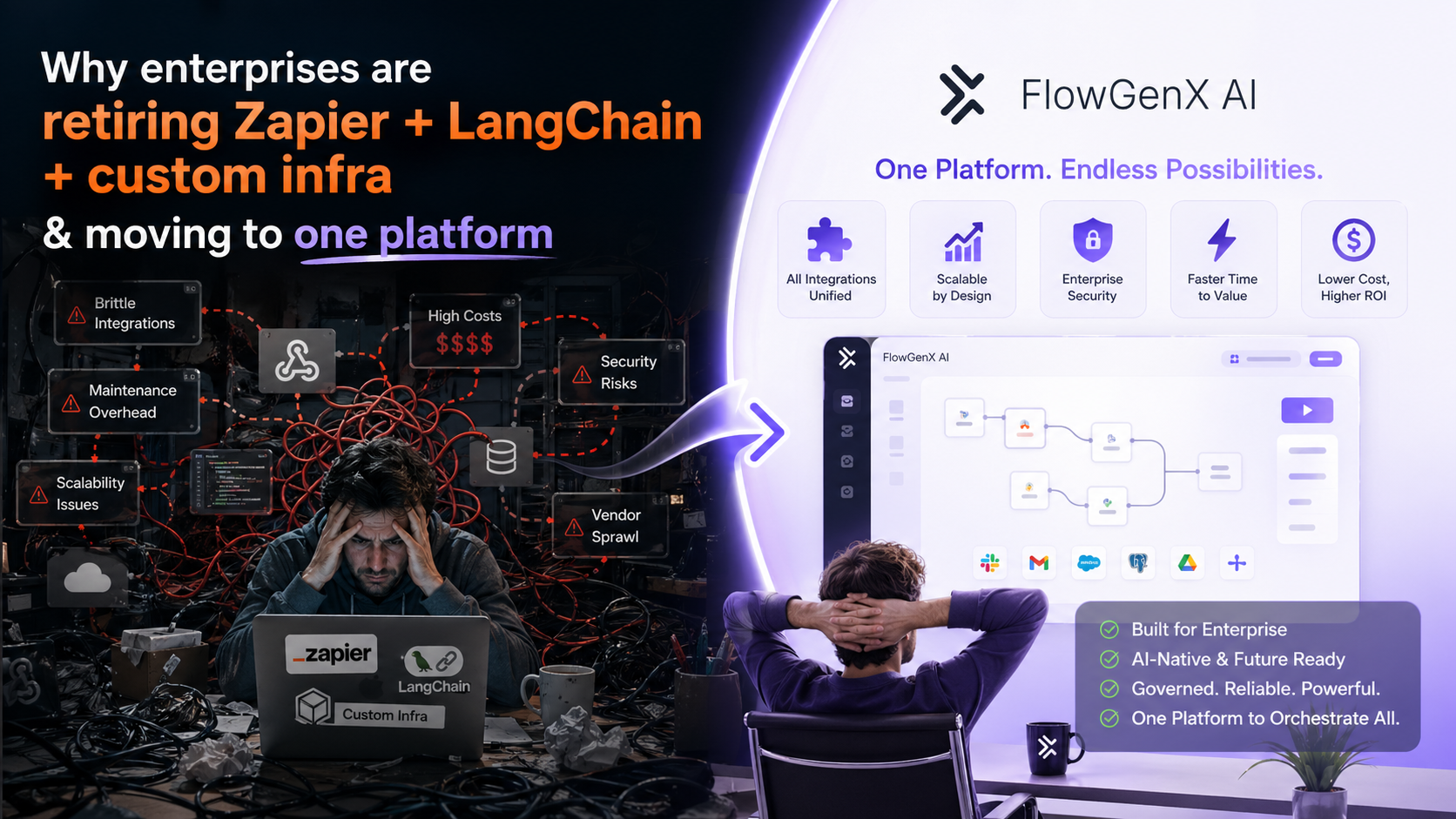
The average enterprise AI team now maintains 4–5 separate tools to do what a single platform should handle end-to-end. Here's the real cost of that fragmentation — and why 2026 is the year smart engineering orgs are finally consolidating.
It starts innocently enough: Zapier for triggers, LangChain for agent logic, a custom Python connector someone wrote over a weekend, Datadog bolted on for visibility. Each decision made sense in isolation. Then production breaks at 2 a.m. and three engineers spend the day triangulating which of the four systems is to blame.
Welcome to the Frankenstein stack — and nearly every enterprise AI team we talk to is running one. This post is about what it's really costing you, and what "one platform" looks like in practice.
The anatomy of the Frankenstein stack
These tools were reasonable local decisions — Zapier for triggers, LangChain for agent logic, Pinecone for vectors, Datadog for observability. The problem is they were never designed to work as a system. They share no data model, no credential vault, no retry policy. Every cross-tool workflow needs custom glue. And glue is what breaks under load.
"We spent three weeks trying to figure out why our LangChain agent was silently dropping 8% of requests. Turned out Zapier was rate-limiting on its side, but LangChain had no visibility into that. We had to instrument the failure ourselves."
— Waqas Abbas, Head of AI Platform
The hidden bill
Enterprises almost always undercount the cost of a fragmented AI stack. They add up SaaS subscriptions and conclude it's "cheap." What they miss is the engineering tax. Connector maintenance alone — keeping custom integrations alive as APIs change, tokens expire, and schemas drift — routinely burns 30–40 engineering hours per month. Add cross-tool debugging and rebuilding auth from scratch for every new integration, and you're spending a full senior engineer's productive month on infrastructure that creates zero product value. At $150–200/hr fully loaded, that's $15,000–$20,000 per month per team — before you account for the features that didn't ship.

Three compounding problems
First, there's no shared execution model — when an agent in LangChain calls a workflow in Zapier that triggers a custom script, each system has its own error taxonomy and retry behavior. When something fails, you're triangulating from three log formats to reconstruct a timeline nobody designed to be reconstructed. Second, auth is reinvented constantly: OAuth token management, API key rotation, and service account scoping are solved three different ways across three tools, producing credential sprawl that security teams flag every compliance cycle. Third, every new integration resets the clock — adding Salesforce as a data source means writing a new LangChain tool, building the OAuth flow, configuring Zapier, updating the observability pipeline, and documenting everything before the person who built it leaves. With a unified platform, you pick from a connector gallery and configure managed auth in a form.
— Chloe Peiris, Head of AI Infrastructure
What a unified agentic platform actually looks like
The consolidation argument isn't "pick one tool and accept its limitations." It's "pick a platform designed from the ground up as a coherent system." A true agentic iPaaS — not a workflow tool with AI bolted on, or an LLM framework with connectors added later — is built around five integrated layers with a shared execution model, shared credential vault, shared observability, and shared governance. Critically, governance isn't layer 5. It's layer 1. Security, audit trails, and data residency controls are the foundation, not a retrofit.
The MCP moment: why 2026 is different
One specific development is accelerating this consolidation: the Model Context Protocol (MCP). MCP does for AI tools what USB did for computer peripherals — one universal interface that eliminates custom integration work. A connector built once works everywhere. Import any REST API and it auto-converts to an MCP tool your agents can discover and call without you writing a single integration function.
FlowGenX is built MCP-native from the ground up — all 200+ connectors are MCP tools. Pair this with the Agent-to-Agent (A2A) protocol — which lets specialized agents delegate tasks, pass context, and coordinate asynchronously — and you have something qualitatively different from a workflow tool or LLM framework. You have infrastructure for a distributed AI workforce.

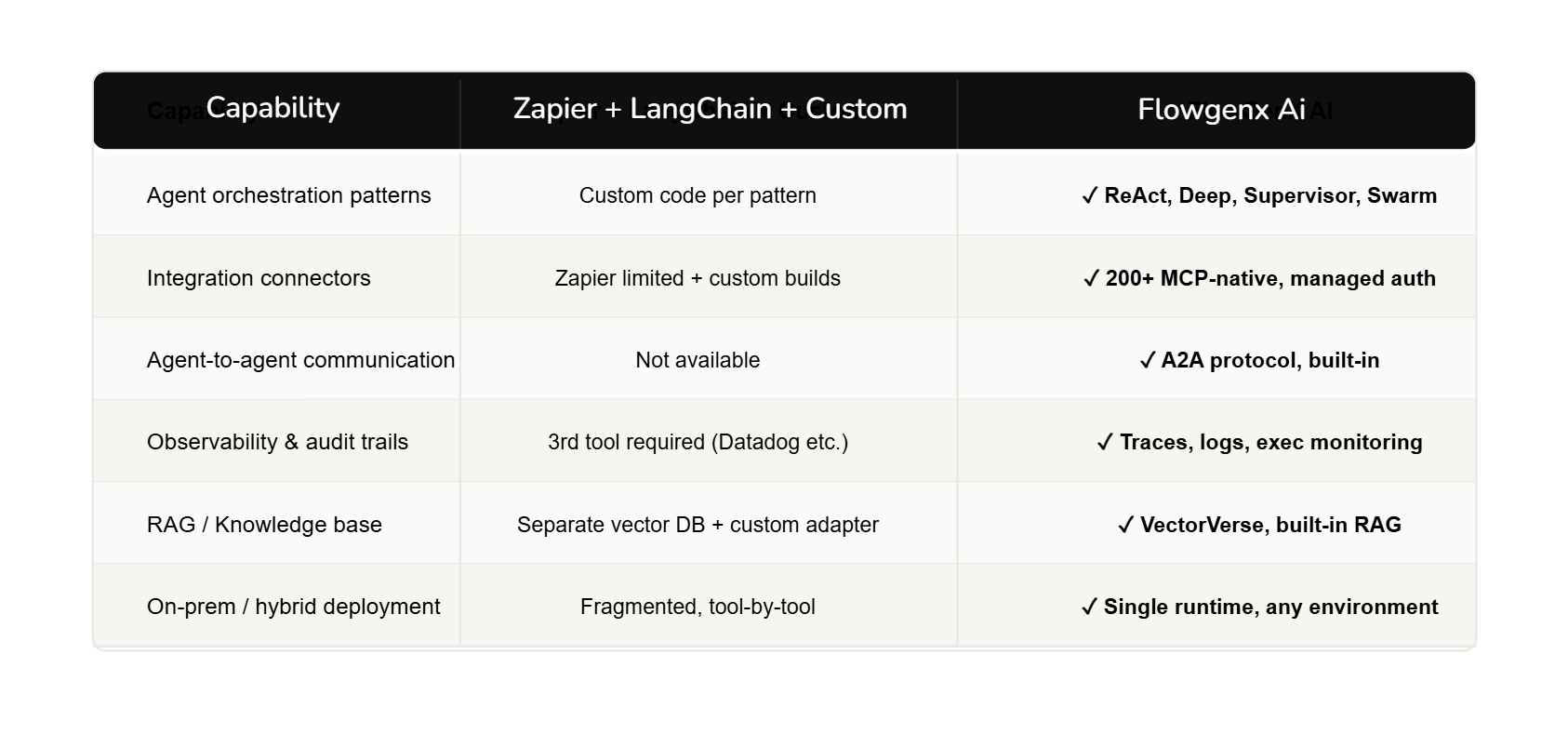
The side-by-side that procurement teams keep asking for
The honest answer to "what do I give up by leaving Zapier and LangChain?" is: very little of substance, and quite a lot of pain. The table below covers the six capabilities that come up most often in enterprise evaluations.
From 6 weeks to 48 hours
In a fragmented stack, deploying a new AI workflow means writing the agent, building connectors, configuring triggers, wiring error handling, deploying each component separately, standing up dashboards, and writing documentation. That's 3–6 weeks for moderate complexity. With FlowGenX: describe the workflow in natural language, refine it in the drag-and-drop canvas, select connectors from the gallery, add human approval gates, and deploy — with observability and audit trails already in place. Hours to days, not weeks. When iteration cycles shrink that dramatically, your team runs more experiments, learns faster, and ships more — the platform becomes a competitive accelerant, not a cost center.
"FlowGenX dramatically cuts the time from AI concept to working pipeline. Complex data orchestration and agent workflows that used to take weeks of custom engineering are now accessible in days — a real shift in time-to-value for enterprise AI teams."
The governance question you can't skip
Every enterprise evaluation surfaces the same compliance question: "Who has visibility into what the AI agents are doing — and can I prove it?" With a fragmented stack, the answer is painful: different audit log formats, separately configured access controls, no central place to trace a single customer data interaction across systems. FlowGenX makes this answerable. Every agent execution is traced end-to-end, every data access is logged, RBAC governs what agents and operators can touch, and human-in-the-loop approval gates can be inserted — and logged — at any step. For financial services, healthcare, or public sector organizations, this isn't optional. It's a procurement gate. And it's the one thing you genuinely cannot bolt on after go-live.
The consolidation is already happening
The iPaaS market hit $12.87 billion in 2024 and is projected to reach $78 billion by 2032 — driven not by "more flows" but by a shift to intent-driven, agentic automation. Around 90% of IT leaders surveyed in 2025 saw processes that would benefit from agentic AI, and 77% planned to invest that same year. The enterprises moving fastest aren't the ones with the most sophisticated custom stacks. They're the ones who recognized earlier that the custom stack was the liability, not the asset.
— Caroline Denker, VP of Engineering
The question in 2026 isn't whether to consolidate — it's when and to what. The Frankenstein stack got you experimenting when no unified option existed. But unified options exist now, they're production-ready, and the engineering tax you pay every month to maintain the old stack is real money your competitors are spending on product. Evaluate your next platform on five criteria: native MCP support, agent pattern breadth, built-in governance, deployment flexibility, and time-to-first-workflow. On all five, the gap has closed.
Request a 30-day full-access trial of FlowGenX AI — no credit card required. Most teams deploy their first production workflow within 48 hours.
Join the conversation with your LinkedIn or Google account